

AI Agents Will Expose the Operating Model You Actually Have
AI agents will not fix a messy operating model. They will expose it.
For years, organizations have relied on people to bridge the gap between the process on paper and the process that actually works. Employees remember which rule can be ignored, which system is wrong, and which exception needs judgment.
When an AI agent enters that workflow, those hidden workarounds disappear.
The real question is no longer just what an agent can do. It is what kind of organization you are giving it permission to reproduce.
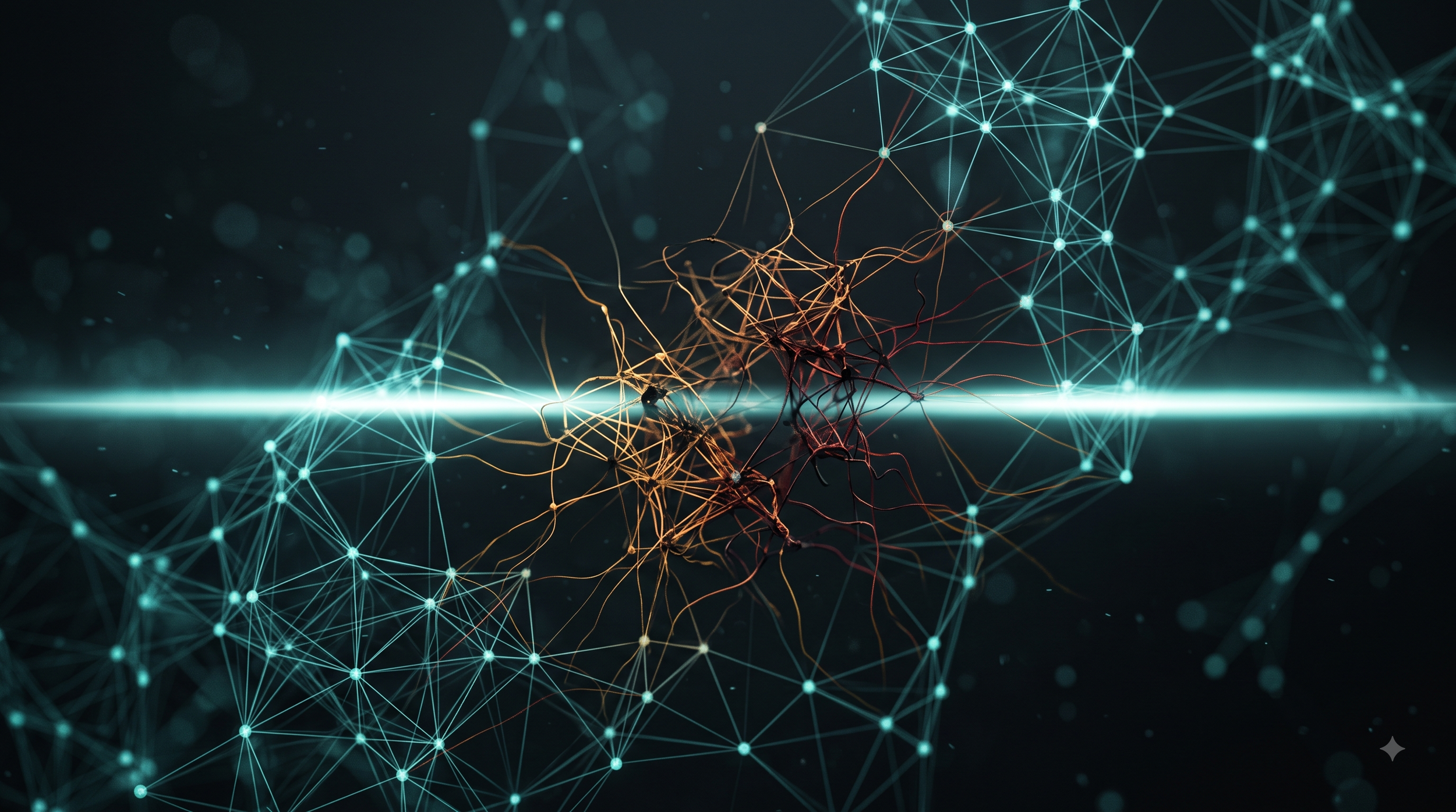
Don't Automate a Problem You Haven't Diagnosed
Everyone is being sold an AI tool that will fix the number that is stuck. But if the problem is not capacity, if it is a broken definition of success or incentives that reward motion over results, the tool does not fix it. It learns the dysfunction, accelerates it, and hides it behind a better dashboard. Before you build or buy, find out what you are actually about to automate.

The People You Keep Are Watching
In the first ten days of May 2026, American companies cut more than thirty-seven thousand jobs. Spirit Airlines shut its doors and let go of all fourteen thousand of its people. PayPal cut a fifth of its workforce. And nearly every announcement pointed at the same culprit, the one everyone is arguing about right now: artificial intelligence.
I am going to make an argument that sounds strange coming from someone who spends half his life inside AI. The machine is not the story. Whether an algorithm can do the job is an interesting question, but it is not the one that will decide these companies' next five years. That question is being answered somewhere else. It is being answered in the hallways, the group chats, and the quiet car rides home of the people who did not get cut.
Because here is what almost every leader gets backwards about a layoff. You think the audience is the people you are letting go. It isn't. The real audience, the one that decides whether your company thrives or slowly bleeds out over the next two years, is the people you keep. And right now, your very best people are watching how you handle this and running a silent calculation. If that is how they treat people here when it gets hard, then what am I, really, to this place.
Whatever they decide in that moment, they rarely say out loud. They just start to hold back.
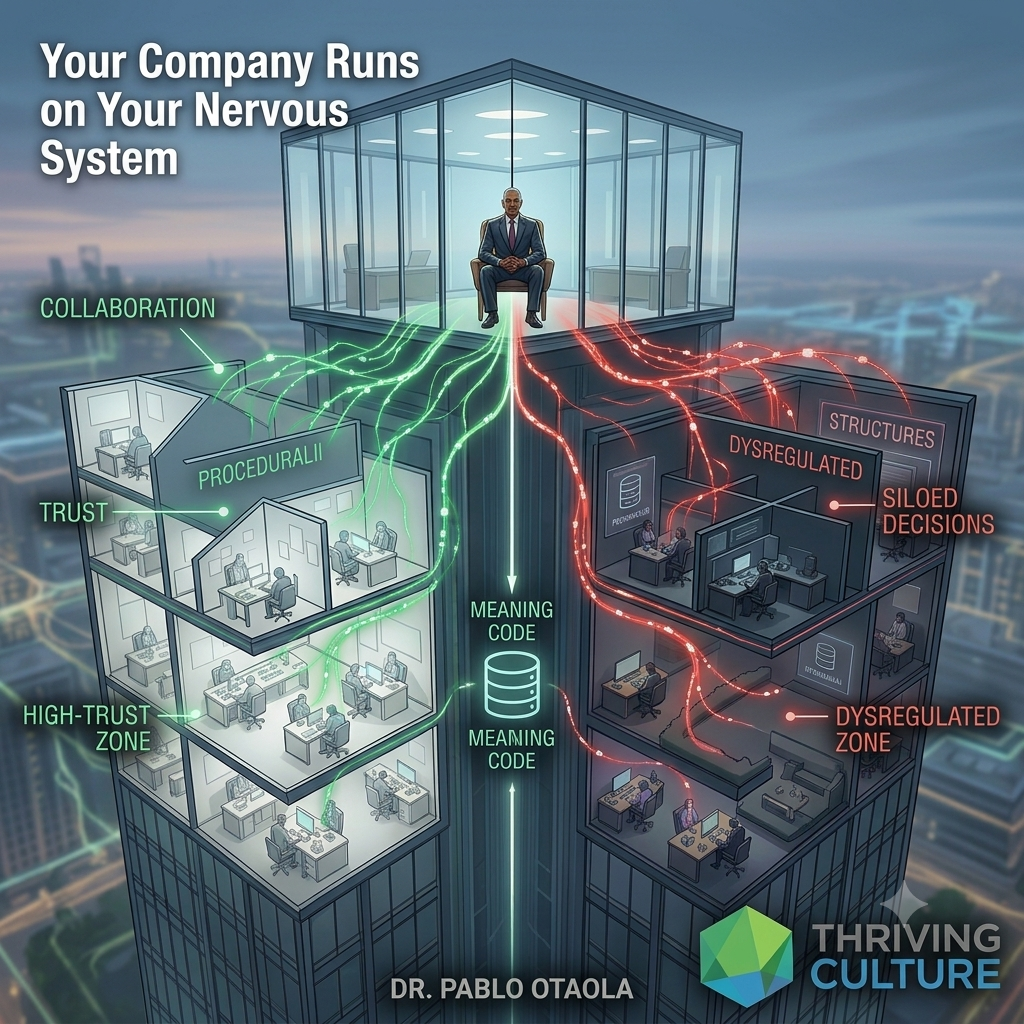
Your Company Runs on Your Nervous System
A CEO I'll call David hired me because his company had a speed problem. Nothing moved without him. Decisions that should have taken a day took three weeks. He was exhausted, and convinced he had hired a building full of people who couldn't make a call.
I watched him in the hard meetings, not the calm ones. And there it was. The moment something went wrong, David changed. His voice dropped, his questions got sharp, and the temperature in the room fell about ten degrees. Nobody got yelled at. It was quieter than that, and worse. People had learned, over years, that being wrong in front of David was dangerous, so they made a rational decision. Don't decide. Wait for him. Let him own it.
David didn't have a company full of people who couldn't make decisions. He had a company that had organized itself, perfectly, around how he behaved under stress.
That is the thing almost no one tells CEOs. You think your company runs on your strategy. It doesn't. It runs on your nervous system. Your people are not calibrating to your best self. They are calibrating to your stressed self, because that is the most consistent signal you send. Anyone can be gracious on a good day. What your organization actually encodes is who you become when the pressure is on.
A Mirror With a Motor
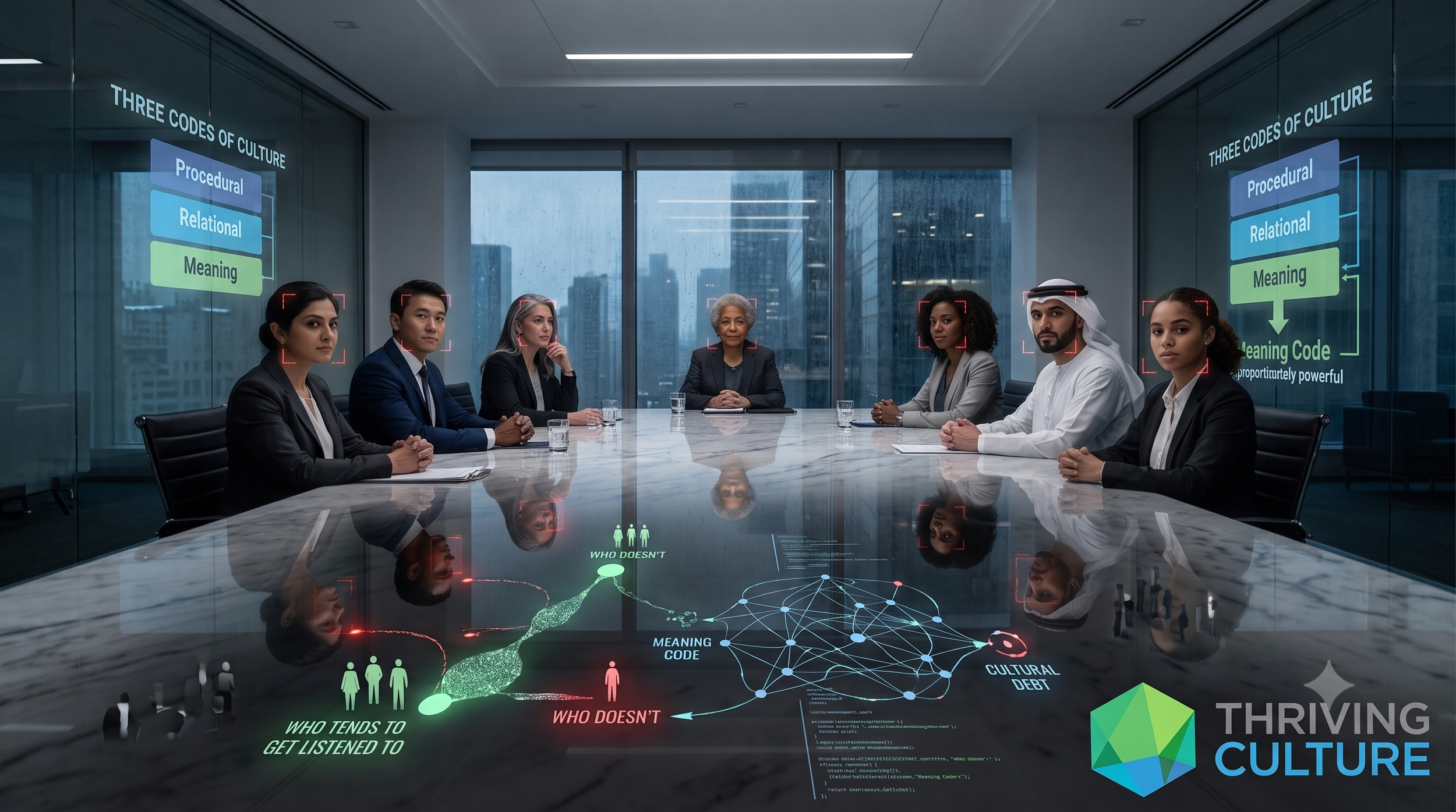
A chief people officer I will call Elena switched on an internal AI agent to route employee requests. It worked. It was fast. Then someone noticed the pattern. It was fast-tracking requests from one part of the business and quietly letting another part wait. Nobody had told it to. It had simply studied years of the company's own data and drawn the obvious conclusion about who tends to get listened to around here and who doesn't. "It's not broken," Elena told me. "That's the part that keeps me up. It's working exactly the way we actually operate. I just never had to see it this clearly before."
An agent is a mirror with a motor. It reflects your culture back at you, and then it acts on the reflection. When you deploy one, you are not handing it the values on your wall. You are handing it your values in use, the things you actually reward, tolerate, and quietly forgive. It learns the culture you have, not the culture you advertise. And then, unlike your people, it never softens a hard edge out of kindness and never quietly declines to do the thing everyone knows is a little bit wrong. It just does it, at scale, at the speed of electricity.
Every organization carries cultural debt, the gap between who we say we are and how we behave when it counts. For decades that debt stayed invisible. Agentic AI compiles it, and ships it straight to production.
We Forgot How to Disagree
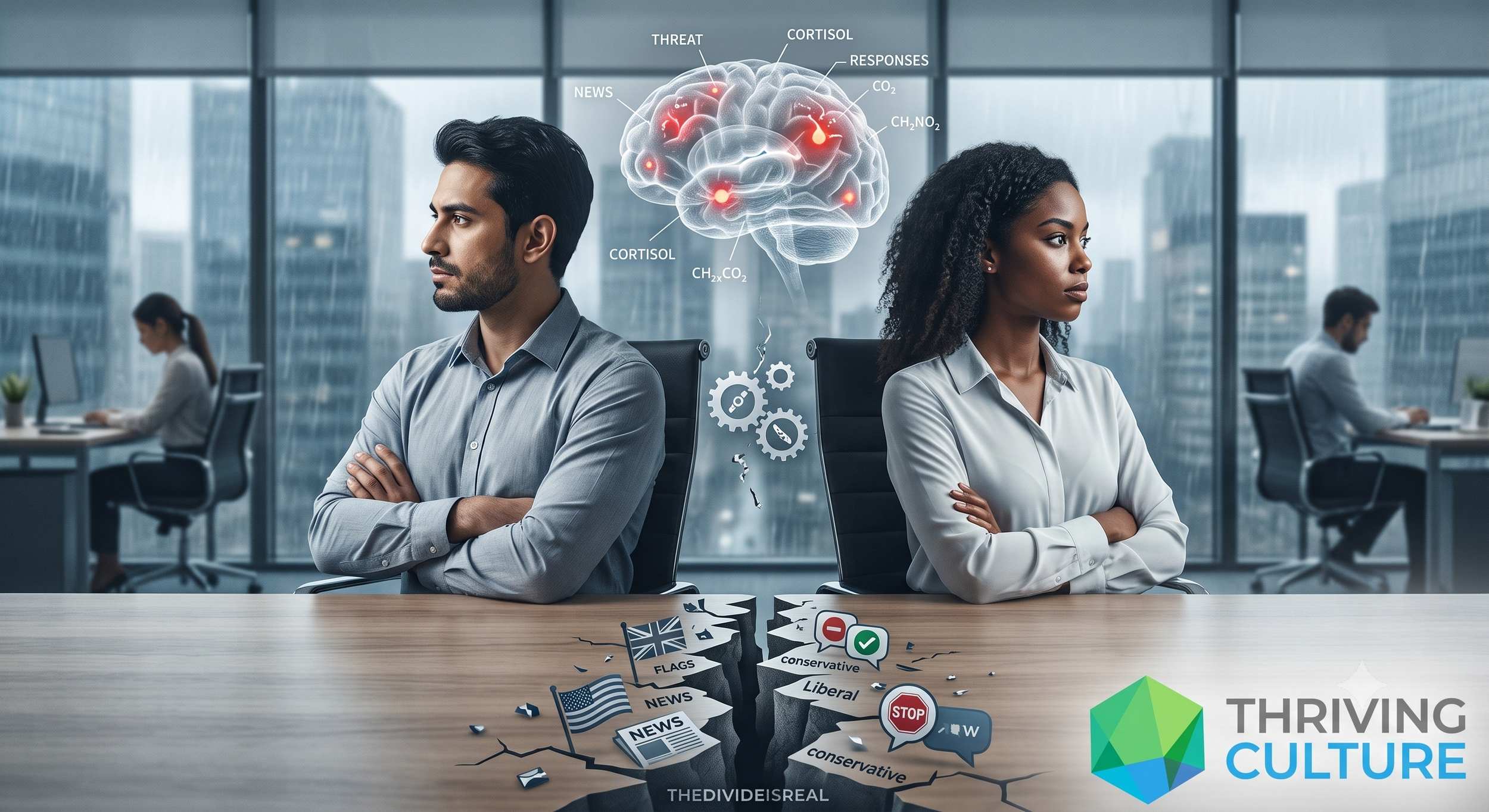
A CEO I will call Dana called me on a Tuesday. Not about strategy, not about numbers, but because two of her best people had stopped speaking to each other. One had made an offhand comment about something in the news. The other said nothing, packed up, and started routing every email around her. Within a month the silence had spread to their teams. Dana's words are the ones I now hear from executives constantly: "I don't even know what we're allowed to talk about anymore, so we've all just stopped talking."
Most leaders read this as a politics problem. It isn't. We do not have a politics problem at work. We have a capability problem. As a country, we have lost the muscle for engaging difference without rupture, and the workplace is simply where that lost muscle becomes most expensive.
The goal was never to get everyone to agree. Healthy cultures are not the ones where everyone thinks alike. They are the ones that have built the capacity to hold real difference without the whole system dropping into threat. And that capacity, like any other, is built or eroded at the top. An organization becomes the behavioral cast of the people who lead it. Your workforce is always watching how the senior team handles disagreement, and quietly calibrating how much of themselves is safe to bring to work.

“Made by Humans”: Why the AI Backlash in Advertising Reveals a Deeper Cultural Anxiety
We’re entering a moment when creativity itself is being renegotiated. Brands are suddenly declaring their work “Made by Humans,” not to rebel against AI, but to protect something far more fragile: the belief that intention still matters. AI can produce content at extraordinary speed, but it can’t embed memory, culture, or lived experience into what it creates. Human creativity leaves fingerprints; emotional, imperfect, meaningful. And as organizations rush toward efficiency, what people are really craving is evidence that someone meant what they made.
This article explores why human authorship is becoming a cultural lifeline, what organizations risk when they abandon intention, and how we can protect the emotional truth at the center of creativity in an increasingly automated world.

When Leadership Fails, the Body Feels It
Leadership collapse begins in the nervous system. Learn how cortisol, communication breakdowns, and cultural intelligence shape organizational stability.

The Human Window: Why Cultural Intelligence Holds Organizations Together in an AI-Accelerated World
As AI accelerates faster than human coping systems, cultural intelligence becomes the stabilizing force organizations desperately need. This blog explores why CQ — not technical skill — will determine which nonprofits thrive in 2026 and beyond.

When AI Becomes a Teammate: How Culturally Intelligent Leadership Turns Automation Into Human Possibility
Nonprofits don’t just struggle with money. They struggle with time. AI, when guided by culturally intelligent leadership, becomes a teammate that restores capacity, reduces burnout, and strengthens relational capital. This is the new frontier of nonprofit work.
Agility Is Cultural: Why Cultural Intelligence Predicts Leadership Success
Agility sounds like the leadership solution everyone is craving in 2025: faster decisions, quicker pivots, teams that can adapt in real time. But agility isn’t universal. It’s cultural. Every expression of “being agile” is filtered through the ten global cultural values that shape how people communicate, take risks, interpret authority, and embrace change.
That’s why some leaders thrive in moments of rapid transformation while others stall. Not because they lack talent, but because they’re leading out of sync with the cultural code of their team. Cultural intelligence (CQ) reveals whether a system can absorb change, how people will interpret speed, and what trust looks like in motion.
Agility builds momentum. Culture builds meaning. And only leaders who understand both can lead real transformation.
The Third Code: When Your Best People Strategy Gets Eaten by Culture
Your most beautiful people strategy is being sabotaged by an invisible force: your organization's Cultural Operating System. Discover the three codes, especially the deep "Meaning Code,” that dictate your success, and learn the shift from Program Manager to Cultural Architect to finally build a culture where your strategy and your people can thrive.

10 Ways Cultural Intelligence and Agentic AI Drive Measurable Organizational Growth
In an era obsessed with Artificial Intelligence, few organizations are asking a deeper question: what happens when technology learns culture?
At Thriving Culture, we’ve spent years proving that Organizational Cultural Intelligence (CQ) is not a soft skill. It’s a measurable driver of performance, retention, and trust. Our research shows that teams with high psychological safety perform 76% better, culturally intelligent leaders build 43% stronger cohesion, and mission-aligned organizations retain donors twice as long.
Now, with the rise of agentic AI (intelligent systems that act with purpose and values) we can finally scale the human side of leadership. By fusing CQ frameworks with AI insights, we help organizations sense trust, predict friction, and evolve culture in real time.
Culture is no longer invisible. It’s intelligent, measurable, and ready to lead.

The AI Revolution Nonprofits Can’t Ignore: How Thriving Culture™ Is Redefining Work, Wealth, and What It Means to Care
Nonprofits are entering the AI revolution not to replace people, but to restore them. Thriving Culture™ helps organizations save money, reduce burnout, and rehumanize work through The Compassion Loop™ automation that multiplies connection, creativity, and care.

Automating HR with Integrity: Keeping Humanity in the Loop
By 2025, HR had quietly become the most overworked department in the nonprofit world. Everyone was talking about burnout, but few were asking why the system itself kept burning people out. Now, nonprofits are discovering that automation can do more than save time; it can restore the space for empathy, reflection, and real human connection.

Cultural Intelligence Is the New Financial Strategy
When federal funding collapsed in 2025, nonprofits faced a reckoning. The ones that survived didn’t just cut costs, they changed how they think. Cultural intelligence became the most powerful financial strategy of all.

Understanding Agentic AI: Beyond Chatbots and Buzzwords
Agentic AI isn’t just another tech buzzword. It’s automation that acts with intention, freeing nonprofit leaders from administrative chaos and helping them reclaim time for mission and meaning. Learn how small nonprofits are using tools they already have, like QuickBooks, Gusto, and Google Drive, to work smarter, ethically, and with cultural intelligence.

Building the Future of the Nonprofit Sector: Where Research Meets Humanity.
The nonprofit sector stands at a crossroads. For decades, we’ve measured success through programs and fundraising, while overlooking the invisible system that determines whether those efforts thrive or fail — organizational culture. Culture is not the “soft side” of leadership; it’s the operating system that drives trust, innovation, and impact. When leaders learn to measure and shape culture through the lens of cultural intelligence, they unlock the full human potential of their teams.
This piece explores how nonprofits can move beyond good intentions to intentional design — using evidence-based practices to build cultures of belonging, accountability, and resilience. It’s a call to reimagine the sector’s greatest asset: its people.
At Thriving Culture LLC, we help mission-driven organizations turn data into dignity, systems into trust, and culture into measurable impact.

The Nonprofit Leader’s AI Toolkit: 5 Free Tools Every Mission-Driven Leader Should Use
Artificial intelligence isn’t replacing the human touch in nonprofits, it’s freeing it. From rewriting grant proposals to transcribing meetings and designing inclusive campaigns, AI can give back the most precious resource leaders lack: time. But as the line between efficiency and ethics blurs, how you use these tools matters as much as what you use.
In this piece, Dr. Pablo Otaola of Thriving Culture explores five free AI tools every nonprofit should be using ChatGPT, Gemini, Notion AI, Canva, and Otter.ai through the lens of cultural intelligence, ethical leadership, and human-centered design. You’ll meet organizations using these tools with wisdom and learn how AI, when guided by trust and transparency, can make leadership more deeply human.

The Nonprofit Leadership Pain Point of 2025: Managing More Change Than Your Org Was Built For
Nonprofit leaders in 2025 are navigating a storm of rising demand, shrinking budgets, and exhausted teams. The problem isn’t strategy—it’s change capacity. Recent research from the Center for Effective Philanthropy and the Urban Institute confirms what many of you already feel: nonprofits are being asked to do more, faster, with fewer resources and less psychological safety.
At Thriving Culture, we’ve seen organizations move from burnout to breakthrough by leading change through cultural intelligence—the capacity to manage complexity across identities, values, and experiences. Whether you’re stabilizing after a leadership transition, rethinking your people strategy, or facing new funding realities, your culture determines how well your team can adapt.
This piece explores what current research reveals about nonprofit resilience and shares real stories from leaders who rebuilt trust, simplified strategy, and made change sustainable again.
CTA: Read the full article to learn how to lead smarter change in 2025